


Pregnancy test strip: What it is, pros and cons, and how to use it correctly
.jpg)
Is a pregnancy test strip right for you? Click to find an in-depth guide dedicated to this type of at-home test to learn about its work, benefits, cons, and more.

A pregnancy test strip is an analog type of at-home pregnancy test. It’s a plain type of test that looks like a thin, white rectangle and works by measuring hCG levels in your urine. It can be chosen over other types of tests thanks to its simplicity, discretion, affordability, availability in packs, and less packaging.
To use a pregnancy test strip correctly, it’s crucial to wait until you miss your period and accurately follow the instructions for greater accuracy.
{{button}}
Whether you’ve been actively trying to conceive or weren’t planning pregnancy, it can be a very emotional moment when it comes to the time to take a pregnancy test. Many women feel anxiety and anticipation before they receive the result. But even before this, they often have plenty of concerns and questions about the type of test to choose, the procedure, interpreting the result, and more.
A pregnancy test strip is one of the basic options that you have for testing for pregnancy. In this article, we’ll talk about this type of test, how it works, what benefits it has, and more.
What Is a Pregnancy Test Strip?
A pregnancy test strip is a type of at-home pregnancy test. It’s also known as an analog pregnancy test.
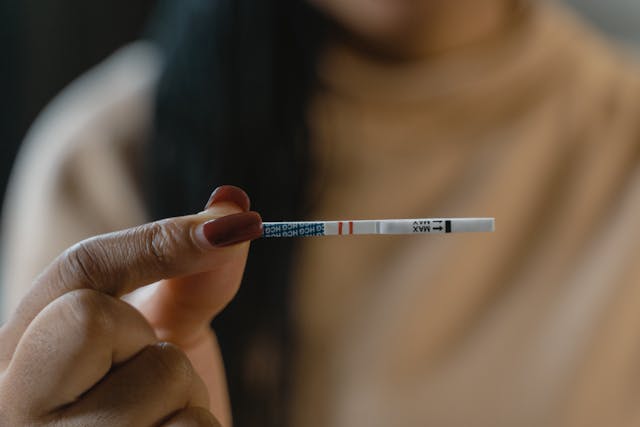
A pregnancy test strip is the most basic type of pregnancy test. It looks like a thin, white rectangle that has an absorbent tip and a small results window with two lines (control and test). It works by detecting the primary pregnancy hormone, human chorionic gonadotropin (hCG), in your pee.
How to Use Pregnancy Test Strip
Compared to some other at-home test types, such as digital, a pregnancy test strip has been around for decades. Its primary benefits are simplicity and ease of use.
To use a test, you only need to take a few steps:
- Pee in a clean cup or container.
- Dip the strip (absorbent tip) into a sample up to the indicated line. Usually, you will need to hold the strip in the pee for a few seconds.
- Lay the strip flat on a surface and wait for several minutes to get the result.
Additional Tips for Results Accuracy
Although most at-home pregnancy tests are very accurate, there are a few things that can affect the result. So, here are a few extra tips for maximum accuracy:
- Wait until the right time. hCG needs time to build up in your body until a test will be able to detect it. Although this hormone starts producing as soon as the embryo implants, it doubles every 48-72 hours in early pregnancy. So testing too early can bring an unclear or false result.
- Pick the right test brand. Even though they may seem identical, some pregnancy tests tend to be less reliable. This can depend on the test’s sensitivity and dye type used in the results window. It’s believed that blue dye tests are more prone to showing an evaporation line and thus, making it harder to interpret the result.
- Do your test first thing in the morning. First morning urine is not yet diluted by the water and other liquids you consume throughout the day, which means that it has the highest hCG concentration. This simplifies pregnancy detection and allows for the most accurate result.
- Follow the instructions carefully. Last but not least, you have to follow the test instructions accurately in order to receive an accurate result. This means waiting for the right amount of time when dipping a test into a sample, laying it flat, and also waiting for the right amount of time until you can read the result. Pro tip: You need to carefully read the instructions for your particular test type and brand. Luckily, they’re always included in the packaging and can also be found online. For example, you can find First Response pregnancy test strip instructions on the brand’s official website.
- Always follow up. Whether you get back a negative or positive pregnancy test strip, consider retesting after 48-72 hours. This will let you confirm the result and gain confidence that it’s accurate.
When Pregnancy Strip Test Can Be Done
Now that you know how to test for pregnancy at home, let’s talk about when pregnancy strip test can be done.
Most test brands emphasize that their strips can correctly detect pregnancy as early as 10 or 12 days post-ovulation (DPO). This might be true. However, the accuracy of the result directly depends on whether your body has already produced enough hCG or not. That is, when you can test is determined by the time of implantation (which is when hCG production begins).
Implantation can occur at any time between 6 and 12 DPO, depending on numerous factors. Sometimes, you might know that implantation has occurred if you experience implantation bleeding. However, not all women experience it. Besides, it’s possible to mistake implantation bleeding for something else.
Due to these reasons, it’s generally recommended to wait and use a pregnancy test strip only after you miss your period. This will give your body enough time to produce sufficient hCG levels and ensure an accurate test result.
How to Read Your Pregnancy Test Strip Results
After you dip the test tip into your urine sample and let it sit (usually for 3-5 minutes), you will see the result in the results section of the strip. So, it’s time to read it.
This kind of test has two definitive results:
- One line – If you only see one, top (control) colored line that appeared on the test strip, it means that you’re not pregnant. The control line is there just to indicate that the test works. Whereas the line (test) located under it only shows if hCG levels have been detected. However, even if you only see one line, this doesn’t always mean that you're not pregnant. Studies show that up to 5% of tests return negative when a woman is actually pregnant. False negatives are especially possible if you’re testing too early or late in the evening when hCG concentration in your urine is very low.
- Two lines – If you see that both control and test lines appear on the strip and are well-pronounced, it means that you are pregnant. In many cases, this is a definitive result because false positives are incredibly rare. However, they are still possible, especially if:
- You do a test soon after sex or a recent miscarriage, abortion, or childbirth.
- Your urine is diluted.
- You left the test in the sample for not enough time.
- You checked the result outside of the time specified in the instructions.
- Your test has expired.
Early Faint Line Positive Pregnancy Test Strip
When testing for pregnancy, most women naturally expect to get a clear result – one or two lines. However, it’s also possible (and not too rare) to receive a non-definitive result.
While there should be no question if both lines on the test are bright and pronounced, sometimes, it’s possible that you get an early faint line positive pregnancy test strip. A faint line is a phenomenon in which the test line is less pronounced or barely visible compared to the control line. This can cause quite a lot of confusion. However, it’s important to note that the test line (one located at the bottom) doesn’t always have to be very pronounced. Sometimes, it can be much fainter compared to the control line. This usually means that you are pregnant, but it’s quite early into pregnancy (hCG levels are still low), or you’ve done your test when your urine is diluted. However, it’s important that it has color.
Pregnancy Test Strip: Pros and Cons
As you probably know, there are plenty of at-home pregnancy test options that you can use today. Apart from a pregnancy test strip, there are cassettes, digital tests, and mid-stream tests. Such a variety of options can easily get you confused and unsure which one to pick. However, a pregnancy test strip has a few undeniable pros:
- Discretion: Compared to stick tests covered in plastic, a test strip is much more compact and lightweight. This makes them easier to store and dispose of after use. They are also less visible in a shared trash can, if this matters to you.
- Affordability: Test strips are much more affordable than other test types. They can cost as little as $0.10-$0.25 each (when you purchase them in packs), compared to a single digital stick that can cost $10 or more.
- Availability in packs: When you need to determine pregnancy, you’ll rarely end up using just one test. In most cases, you will want to do at least one or a few follow-up tests to confirm the result. That’s when buying a pack of strips is more convenient than purchasing multiple digital sticks that are often sold individually.
- Less packaging: Because they are much smaller, simpler (not covered in plastic or having electronic parts), and often come in packs, test strips have less packaging compared to other test types. If you care about the environment, this might be another significant benefit.
Now, what about the cons? Frankly speaking, there are no significant cons of a pregnancy test strip, in particular. We could say that there is a likelihood of a false result or faint line, but this is also true for other types of at-home tests. So, basically, you need to pick a test based on your individual needs and wants.
Conclusion
Today, women have access to a number of at-home test options to detect if they are pregnant or not. A pregnancy test strip might be the most basic option. Yet, it has been around for a while and thus is considered rather reliable. Besides, it’s very simple, so you won’t have to wonder how to use pregnancy test strip.
Even if this is your first time testing for pregnancy, after reading this guide, you should have all the information you need. Now, you know about the specs, pros, and cons of a pregnancy test strip, as well as understand how and when to use it. Use the information and tips we shared with you here to test for pregnancy correctly and get an accurate result.
{{pink-banner}}



.avif)
